
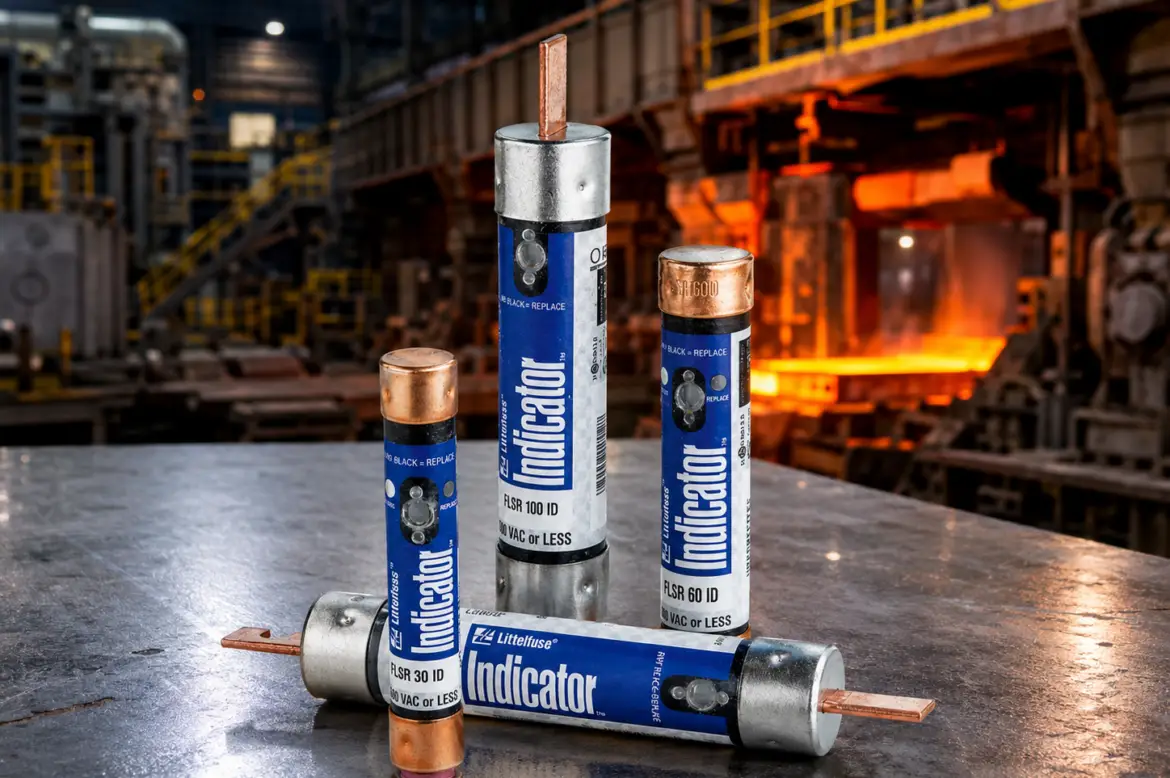
Industrial electrical systems depend on properly selected overcurrent protection to limit equipment damage, isolate faults and reduce unnecessary downtime.
Fuses are used throughout manufacturing plants, warehouses, commercial facilities, motor-control centers, machinery and electrical-distribution systems. Although many industrial fuses look similar, their voltage rating, ampere rating, interrupting capacity, time-current characteristics and UL fuse class determine where they may be used.
CAPO Supply carries Littelfuse industrial fuses, including the widely used FLSR Class RK5 series, along with other fuse types for motors, transformers, control circuits, feeders and distribution equipment.
What Does an Industrial Fuse Do?
A fuse contains an element designed to open when current exceeds an acceptable level for a sufficient amount of time.
This protects conductors and equipment from two primary conditions:
- Overloads, where a circuit draws more current than intended over time
- Short circuits, where a fault produces a rapid and potentially destructive increase in current
Once a fuse opens, it must be replaced. This provides a clear indication that the circuit experienced an overcurrent condition, but the underlying cause should be identified before power is restored.
A fuse should never be replaced with a larger ampere rating simply to prevent it from opening. Doing so can remove the intended protection from the circuit.
Littelfuse FLSR Class RK5 Fuses
The Littelfuse FLSR series is a family of dual-element, time-delay Class RK5 fuses. Littelfuse describes FLSR as its most widely used fuse class and recommends it for many circuit types, particularly applications involving motors.
FLSR fuses are rated for systems up to 600 volts AC and are available across a broad range of ampere ratings. Smaller ratings use cartridge-style bodies, while larger ratings use knife-blade construction.
Why FLSR Fuses Use a Dual-Element Design
The dual-element construction allows the fuse to respond differently to overloads and high-level short circuits.
One element provides time delay during temporary current surges, while the other responds rapidly to severe fault current. This makes the fuse suitable for equipment that draws a normal but brief inrush current during startup.
Common examples include:
- Motors
- Transformers
- Solenoids
- Compressors
- Pumps
- Fans
- Conveyors
- HVAC equipment
- Industrial machinery
A fast-acting fuse may open unnecessarily during normal motor starting. An FLSR time-delay fuse is designed to tolerate an appropriate temporary surge while still providing overload and short-circuit protection.
Common Applications for FLSR Fuses
FLSR fuses are commonly found in:
- Fused safety switches
- Motor disconnects
- Motor-control centers
- Combination motor starters
- Machinery disconnects
- Feeder circuits
- Branch circuits
- HVAC equipment
- Pumps and compressors
- Industrial control panels
Their broad application range makes them a common replacement item for electricians, maintenance departments and industrial facilities.
Current-Limiting Protection
FLSR fuses are current-limiting Class RK5 devices.
During a high-level fault, a current-limiting fuse can open before the fault current reaches its full potential peak. This reduces the amount of fault energy allowed to pass downstream.
Current limitation can help reduce:
- Thermal damage
- Magnetic forces
- Conductor damage
- Equipment damage
- Stress on switches and enclosures
- The severity of a short-circuit event
The available fault current, equipment rating and fuse characteristics must all be considered when designing or servicing the system.
Rejection-Style Class R Fuse Protection
Class R fuse holders use a rejection feature intended to prevent the installation of certain lower-performance fuse classes in equipment designed for Class R fuses.
This helps stop someone from substituting a physically similar fuse with a lower voltage rating, interrupting rating or protective capability. Littelfuse notes that Class R fuses fit Class R holders designed to reject non-Class-R replacements.
The rejection feature should not be defeated or modified.
FLSR_ID Indicating Fuses
Littelfuse also offers indicating versions of the FLSR family under the FLSR_ID designation.
These dual-element, time-delay Class RK5 fuses include an indication feature that helps maintenance personnel identify an opened fuse. Littelfuse lists the FLSR_ID series as 600-volt AC fuses available from 1 through 600 amps.
Indicating fuses can be useful in three-phase equipment, control panels and larger facilities where quickly locating an open fuse may reduce troubleshooting time.
Class J Fuses: Littelfuse JTD
The Littelfuse JTD series consists of dual-element, time-delay Class J fuses designed for applications where high performance and compact dimensions are required.
Littelfuse states that JTD fuses use its POWR-PRO technology and are specifically designed for circuits where space is limited.
Common applications include:
- Motor circuits
- Industrial machinery
- Feeder protection
- Control panels
- HVAC equipment
- Disconnect switches
- Compact electrical equipment
Class J fuses have unique dimensions that help prevent substitution with another fuse class. They are commonly rated for systems up to 600 volts AC, with ratings extending into larger knife-blade configurations.
JTD_ID versions are also available when fuse-open indication is desired.
Class CC Fuses
Class CC fuses are compact, current-limiting fuses commonly used in industrial control circuits and smaller motor applications.
They are generally used in ratings up to 30 amps and have a rejection design that helps prevent the installation of unsuitable replacement fuses.
Two important Littelfuse Class CC families are KLDR and CCMR.
Littelfuse KLDR
The KLDR series consists of time-delay Class CC fuses designed for control transformers, solenoids and similar inductive components that experience high magnetizing current during startup.
KLDR applications commonly include:
- Control transformers
- Solenoids
- Industrial controls
- Motor starters
- Contactors
- Control-power circuits
- Small motor branch circuits
Littelfuse offers KLDR fuses with ratings up to 600 volts AC and 300 volts DC, depending on the specific part number.
Littelfuse CCMR
The CCMR series is a time-delay Class CC fuse designed primarily for motor circuits.
Littelfuse identifies CCMR fuses as suitable for motor circuits up to 40 horsepower, depending on the system voltage and application. Their time-delay characteristics help prevent unnecessary openings during normal motor starting.
Common applications include:
- Motor starters
- Pumps
- Fans
- Conveyors
- Machine tools
- HVAC equipment
- Industrial control panels
KLDR and CCMR fuses are both Class CC products, but they are optimized for different load characteristics. The existing fuse designation and equipment documentation should be checked before selecting a replacement.
Class RK1 Fuses
Class RK1 fuses provide a higher degree of current limitation than many general-purpose fuse types.
Littelfuse offers fast-acting RK1 products such as the KLSR and KLNR series. Their single-element silver-link design provides fast response to overloads and short circuits.
Fast-acting RK1 fuses may be used for:
- Feeders
- Resistive loads
- Distribution circuits
- Equipment requiring fast fault response
- Circuits without substantial startup current
They are generally not the first choice for motors or transformers unless properly sized for the inrush current. Littelfuse notes that fast-acting KLSR fuses may need to be substantially oversized on inductive loads to avoid nuisance operation.
Time-delay RK1 products are also available for applications requiring both strong current limitation and inrush tolerance.
Class L Fuses
Class L fuses are designed for high-current electrical-distribution applications.
They are commonly found in:
- Main switchboards
- Large service equipment
- Large feeders
- Industrial distribution systems
- Generator systems
- Large disconnects
- High-capacity equipment
Class L fuses are physically larger and are used at ampere ratings above those normally served by Class R or Class J fuses.
These fuses should be selected as part of the overall distribution-system design, including available fault current and selective-coordination requirements.
Class T Fuses
Class T fuses offer high interrupting capability in a compact body.
They are commonly used where equipment space is limited, including:
- Compact disconnects
- Battery systems
- Drives
- UPS equipment
- Industrial control equipment
- Distribution equipment
- Certain renewable-energy systems
The physical size and blade configuration vary by ampere rating, so the fuse and holder must be matched carefully.
Fast-Acting vs. Time-Delay Fuses
The difference between fast-acting and time-delay fuses is critical.
Fast-acting fuses
Fast-acting fuses respond quickly when current exceeds their operating threshold.
They are often used for:
- Resistive loads
- Feeder circuits
- Semiconductor protection when specifically designed for it
- Equipment without significant startup current
- Circuits requiring rapid fault response
Time-delay fuses
Time-delay fuses tolerate temporary current surges without opening immediately.
They are often used for:
- Motors
- Transformers
- Solenoids
- Compressors
- Pumps
- Fans
- Other inductive loads
A time-delay fuse does not provide less protection simply because it allows temporary inrush. Its time-current response is designed to distinguish normal startup conditions from sustained overloads and short circuits.
How to Read a Fuse Part Number
Industrial fuse designations often identify the fuse family followed by the ampere rating.
Examples include:
- FLSR30: FLSR series, 30 amps
- FLSR60: FLSR series, 60 amps
- FLSR200: FLSR series, 200 amps
- KLDR10: KLDR series, 10 amps
- CCMR20: CCMR series, 20 amps
- JTD100: JTD series, 100 amps
Formatting can vary, especially for fractional ratings or indicating versions. Always confirm the complete catalog number printed on the fuse body.
What to Check Before Replacing an Industrial Fuse
Before selecting a replacement, verify:
- Manufacturer and series
- UL fuse class
- Ampere rating
- AC and DC voltage rating
- Time-delay or fast-acting operation
- Interrupting rating
- Cartridge or blade configuration
- Physical dimensions
- Fuse-holder compatibility
- Indicating or non-indicating construction
- Equipment manufacturer requirements
- Available fault current
- Application and load type
Matching only the ampere rating is not sufficient. Two fuses with the same amperage can have different voltage ratings, dimensions, interrupting ratings and operating characteristics.
Never Substitute Fuse Classes Without Review
A fuse from another class should not be installed simply because it appears to fit.
Substitution can affect:
- Interrupting capacity
- Current limitation
- Equipment protection
- Selective coordination
- Motor-starting performance
- Equipment listing
- Arc-flash calculations
- Code compliance
When an exact fuse is unavailable, an approved equivalent should be selected using manufacturer cross-reference information and a complete review of the electrical characteristics.
Investigate Why the Fuse Opened
A fuse is not usually the cause of an electrical problem. It is responding to one.
Possible causes include:
- Shorted conductors
- Ground faults
- Failed motors
- Locked rotors
- Overloaded equipment
- Failed contactors
- Damaged heaters
- Transformer faults
- Loose or overheated connections
- Incorrect fuse sizing
- Repeated equipment cycling
Replacing a fuse without testing the circuit can result in another opening or additional equipment damage.
Troubleshooting and energized electrical work should be performed only by qualified personnel following appropriate electrical-safety procedures.
Littelfuse Industrial Fuses from CAPO Supply
Littelfuse manufactures a broad range of current-limiting industrial fuses, including Class RK5, RK1, J, CC, T, G and L products for AC and DC systems.
CAPO Supply carries Littelfuse FLSR fuses and other industrial fuse types for motors, controls, transformers, machinery, disconnects and distribution equipment.
Bring us the complete fuse number, a clear photo of the fuse label or the equipment information. Our team can help identify the correct Littelfuse replacement and the matching fuse block, holder or disconnect components required for the job.
Contact CAPO Supply for current Littelfuse fuse availability and assistance identifying the correct industrial overcurrent-protection product.