
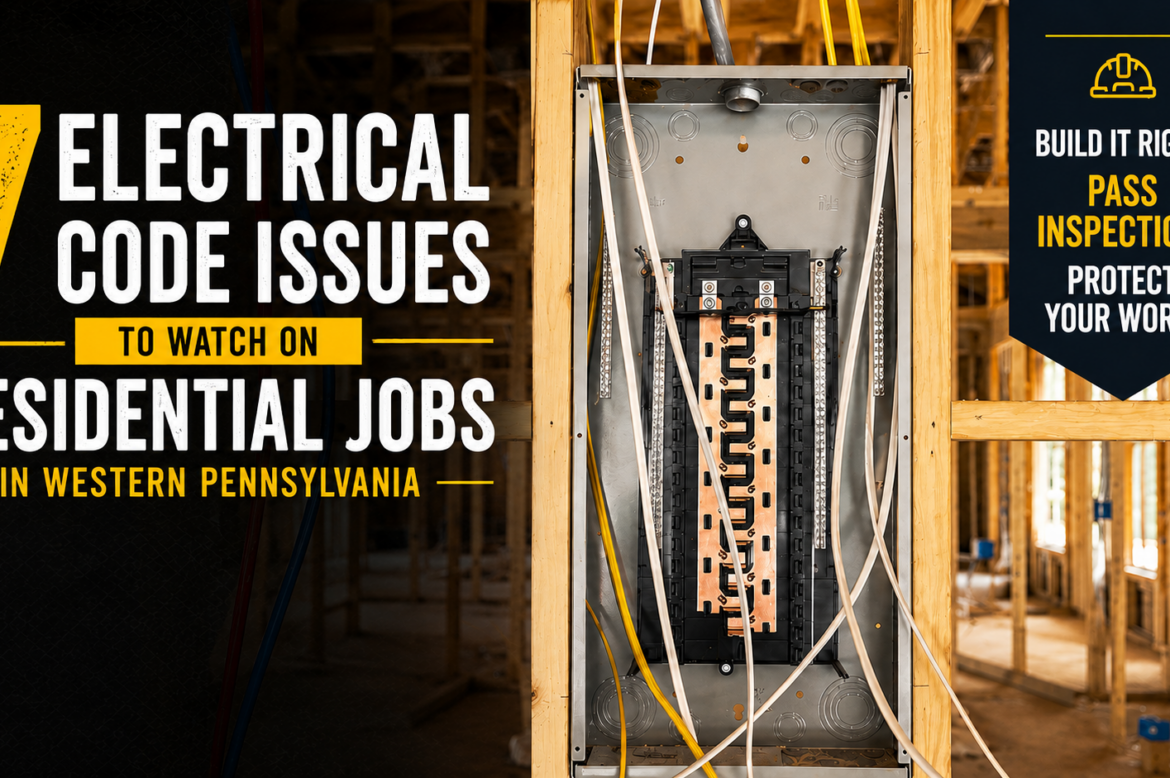
Electrical work is one of those trades where doing something the way it has been done for years does not necessarily mean it meets the code being enforced today.
That is especially worth remembering in Pennsylvania in 2026. The Commonwealth’s Uniform Construction Code (UCC) went through a triennial update that became effective January 1, 2026. For residential construction, Pennsylvania adopted the 2021 International Residential Code (IRC), with state-specific exclusions and modifications. The electrical provisions in the 2021 IRC are based on the 2020 National Electrical Code (NEC/NFPA 70).
For electricians working in New Castle, Sharon, Lawrence County, Mercer County and the surrounding Western Pennsylvania area, that makes this a good time to revisit several requirements that can affect everyday residential work—from a kitchen remodel to a 200-amp service upgrade.
Here are seven areas worth watching.
1. GFCI Protection Goes Well Beyond Bathrooms and Kitchen Countertops
Most electricians do not need a reminder that bathrooms and kitchen countertops require GFCI protection. The bigger issue is how much broader the requirement has become.
Under the electrical provisions of the 2021 IRC, corresponding to NEC 210.8, GFCI protection applies to receptacles in numerous residential locations, including bathrooms, garages, outdoors, crawl spaces, basements, laundry areas and receptacles located within the prescribed distance of sinks, bathtubs and shower stalls. The current residential provisions also cover qualifying 125- through 250-volt receptacles, so thinking of GFCI strictly as a 120-volt receptacle requirement can lead to problems.
There is another important distinction: certain outdoor outlets, not merely ordinary receptacles, can also require personnel GFCI protection under the 2020 NEC-based rules. That can become relevant when planning outdoor residential equipment.
For remodel work in particular, it is worth looking at the entire space instead of simply replacing what was already there. An older basement, garage or laundry room may have existing receptacles that were acceptable under an earlier code cycle but would not represent the layout or protection required for new work today.
Practical takeaway: When estimating a residential renovation, count GFCI protection as part of the circuit design—not something to figure out after the trim-out.
2. AFCI Is No Longer Something to Think About Only in Bedrooms
Arc-fault circuit-interrupter protection is another area where older habits can cause confusion.
The 2021 IRC electrical provisions require AFCI protection for qualifying 120-volt, single-phase, 15- and 20-amp branch circuits supplying outlets in a broad range of residential spaces. That includes kitchens, family rooms, dining rooms, living rooms, bedrooms, libraries, dens, sunrooms, recreation rooms, closets, hallways, laundry areas and similar rooms or areas. See IRC E3902.20, corresponding to NEC 210.12(A).
The remodel side of the rule deserves particular attention.
IRC E3902.21 addresses branch-circuit extensions and modifications. When existing branch-circuit wiring is modified, replaced or extended in an area where AFCI protection is required, AFCI protection can become part of the work. There is a limited exception involving an extension of no more than six feet with no added outlets or devices other than splicing devices, but it should not be interpreted as a blanket exemption for remodels.
That means something as ordinary as opening a kitchen wall, moving receptacles or extending an existing circuit deserves a code check before assuming that the existing breaker can remain exactly as it is.
Practical takeaway: AFCI is a whole-house planning issue on modern residential work, not a bedroom-only requirement.
3. Service Upgrades Need an Outdoor Emergency Disconnect Check
This is a particularly important one for electricians doing residential service changes.
The 2021 IRC contains an emergency-disconnect requirement in E3601.8, corresponding to NEC 230.85. The model code requires the service conductors for covered one- and two-family dwellings to terminate in an emergency disconnect located outdoors in a readily accessible location.
But Pennsylvania made a specific modification to this section.
As part of the 2026 UCC update, Pennsylvania inserted the word “detached” into E3601.8 so that the provision applies to detached one- and two-family dwelling units. That is exactly the kind of state amendment that can be missed if someone is working only from a generic summary of the 2021 IRC or 2020 NEC.
For a typical detached house undergoing a service replacement or an upgrade from an older 100-amp service to 200 amps, the location and configuration of the disconnect should therefore be considered while the service is being designed—not after the new panel, meter equipment and service entrance material have already been purchased.
Depending on the service arrangement, a meter-main combination or other listed outdoor disconnecting equipment may be part of the solution.
The distinction also affects grounding and bonding. Once a disconnect is moved ahead of equipment traditionally treated as the main panel, the electrician needs to understand where the service disconnect is located and what equipment is now on the load side of it.
Practical takeaway: On a residential service change, establish the service/disconnect arrangement first. It can affect the meter equipment, panel configuration, grounding and bonding, conductor selection and the material list for the entire job.
4. Whole-House Surge Protection Is Now Part of Service Planning
Surge protection has traditionally been viewed by many homeowners as an optional upgrade. Under the 2020 NEC-based residential provisions now incorporated into the 2021 IRC, it is part of the service requirements.
IRC E3606.5 requires services supplying one- and two-family dwelling units to have a surge-protective device (SPD). The SPD is generally required to be integral to or immediately adjacent to the service equipment, with provisions for installation at downstream distribution equipment in the circumstances addressed by the code. The residential provision specifies a Type 1 or Type 2 SPD.
There is an especially important sentence for retrofit work: when service equipment is replaced, the surge-protection requirements apply. That provision corresponds to NEC 230.67.
This makes surge protection something that should be included when quoting the service—not treated as an optional accessory mentioned after the rest of the job is complete.
There is also a practical reason homeowners can understand. Modern homes contain an enormous amount of electronics compared with houses built 30 or 40 years ago: appliances, HVAC controls, televisions, computers, networking equipment, smart-home devices, LED electronics and countless electronic power supplies.
Practical takeaway: If service equipment is being replaced, make the SPD part of the bill of material from the beginning.
5. Grounding and Bonding Are Related, but They Are Not the Same Thing
“Grounding” and “bonding” get used interchangeably in casual conversation, but electrically they perform different functions—and a mistake involving the neutral, equipment grounding conductor or grounding electrode system can create a serious problem.
At the service, the grounded conductor and grounding system are connected through the required service bonding arrangement. Once you move to the load side of the service disconnecting means, however, the grounded conductor—the neutral—generally is not reconnected to normally non-current-carrying metal parts or the equipment grounding conductor. The 2021 IRC addresses this directly in E3908.7, corresponding to NEC 250.24(A)(5).
In other words, finding the green bonding screw or bonding strap in the box does not automatically mean it should be installed.
This becomes especially important on older houses where electricians encounter:
- panel replacements;
- subpanels added years ago;
- old three-wire feeder arrangements;
- multiple grounding electrodes;
- plumbing that has been partially replaced with nonmetallic pipe; and
- garages or other accessory buildings fed from the house.
The code also makes a fundamental point that is worth remembering: the earth itself is not considered an effective ground-fault current path. The equipment grounding and bonding system provides the low-impedance fault-current path needed for the protective device to operate.
That is why adding a ground rod does not correct an improperly installed equipment grounding conductor or an incorrect neutral-to-ground connection downstream.
Practical takeaway: Whenever service or feeder equipment changes, trace the grounding and bonding arrangement as a system. Do not look at the ground rods, neutral bar, grounding bar and bonding hardware as unrelated pieces.
6. Pennsylvania Has Its Own Rule to Watch for Kitchen-Island Receptacles
Here’s a Pennsylvania-specific detail that is easy to miss.
The unmodified 2021 IRC E3901.4.2 changed the method for determining receptacle requirements at island and peninsular countertops. Instead of the older dimensional threshold, the 2021 model-code language bases the number of outlets on countertop/work-surface area.
Pennsylvania did not adopt that section as written.
In its 2026 UCC update, Pennsylvania specifically excluded 2021 IRC E3901.4.2 and retained the previously adopted 2018 IRC E3901.4.2 for island countertop spaces.
The retained 2018 provision uses the older threshold: an island countertop space at least 24 inches long and 12 inches wide requires at least one receptacle outlet.
This is exactly why it is risky to search the internet for “2021 IRC kitchen island outlet requirements,” read the first national result and assume it is the rule being enforced on a Pennsylvania project.
Pennsylvania adopted the 2021 IRC with modifications, and those modifications matter.
Kitchen remodels are already material-intensive jobs involving countertop circuits, appliance circuits, AFCI protection, GFCI protection, receptacle locations and often panel work. The island layout should be reviewed before rough-in rather than waiting until the cabinets and countertop are installed.
Practical takeaway: For Pennsylvania jobs, use the Pennsylvania-adopted version of the code, not just the unamended national model code.
7. A Detached Garage Is More Than “Running Power Out to the Garage”
Detached garages and accessory buildings are common throughout Western Pennsylvania, and they can bring several code requirements together on one relatively small job.
When a separate building is supplied by a feeder, IRC E3607.3 generally requires a grounding electrode system at that building. The equipment grounding conductor is run with the feeder conductors and connected to the building disconnect and grounding electrode system. The grounded conductor—the neutral—is not bonded back to the equipment grounding conductor or grounding electrode at the detached building under the normal new-installation arrangement.
There is an important distinction for a building supplied by only one branch circuit, including a qualifying multiwire branch circuit. The code provides an exception to the grounding-electrode requirement where that branch circuit includes an equipment grounding conductor. Existing installations can also have their own exceptions and conditions, which is another reason not to apply a new-work diagram blindly to an older garage.
Then the rest of the garage still has to be considered: disconnecting means, receptacle requirements, GFCI protection, conductor and raceway protection, and equipment exposed to damp or wet conditions.
Outdoor equipment also needs to be selected for the environment. The IRC requires appropriate weather-resistant receptacles and weatherproof enclosure arrangements for receptacles installed in wet locations, and cabinets or panelboards installed in wet locations must be weatherproof and installed to prevent water from accumulating in the enclosure.
That’s especially relevant in Western Pennsylvania, where exterior equipment has to live through rain, snow, freeze/thaw cycles and plenty of moisture.
Practical takeaway: Treat a detached-building circuit or feeder as a complete electrical system, not simply a length of cable between two panels.
The Code Book Is Only Part of the Job
Pennsylvania has a statewide construction code, but code administration is largely local. The Department of Labor & Industry reports that more than 90% of Pennsylvania municipalities administer and enforce the UCC themselves or through certified third-party agencies.
That means the Authority Having Jurisdiction (AHJ) still matters.
The City of New Castle maintains its own Code Enforcement Department, and the City of Sharon’s Code & Zoning Enforcement Department handles building permits and inspections, including a permit process that directs applicants to the appropriate building-code inspector.
For contractors working outside those city limits, the responsible municipality or third-party inspection agency may be different.
The best approach is simple: identify the applicable code and Pennsylvania amendments, confirm any project-specific requirements with the AHJ, and build the material list around the installation that will actually be inspected.
That can prevent a return trip, a failed inspection and, often most importantly, having to redo finished work.
Electrical Material for Your Next Western Pennsylvania Project
Whether the job involves a service upgrade, kitchen remodel, detached garage, new circuits or exterior electrical work, planning the material around the current requirements can save significant time once the job is underway.
CAPO Supply can help contractors source the electrical material needed for residential and commercial projects throughout the Sharon, New Castle and surrounding Western Pennsylvania area. From load centers, circuit breakers and wiring devices to grounding products, conduit, fittings, boxes, covers, enclosures and other electrical supplies, talk to us before the job starts or send us a quote request for your next project.
Official Resources and Further Reading
- Pennsylvania Department of Labor & Industry — Uniform Construction Code:
https://www.pa.gov/agencies/dli/programs-services/labor-management-relations/bureau-of-occupational-and-industrial-safety/uniform-construction-code-home - Pennsylvania Bulletin — 2026 UCC Update / 2021 IRC Adoption and Pennsylvania Modifications:
https://www.pacodeandbulletin.gov/secure/pabulletin/data/vol55/55-45/55_45_rr.pdf - International Code Council — 2021 IRC, Electrical Provisions:
https://codes.iccsafe.org/content/IRC2021P3/chapter-39-power-and-lighting-distribution - International Code Council — 2021 IRC, Residential Services, Grounding and Bonding:
https://codes.iccsafe.org/content/IRC2021P3/chapter-36-services - City of New Castle — Code Enforcement:
https://www.newcastlepa.org/departments/code-enforcement/ - City of Sharon — Code & Zoning Enforcement:
https://www.cityofsharon.net/departments/CodeEnforcement
Disclaimer: This article is intended as general industry information and is not a substitute for the adopted Pennsylvania Uniform Construction Code, the NEC/IRC provisions incorporated by reference, manufacturer instructions, engineered plans or requirements of the Authority Having Jurisdiction. Code requirements can depend on the scope and date of the project, existing conditions, Pennsylvania amendments and local enforcement. Contractors should verify the requirements applicable to each project before installation.